
By Kent Johnson and Olga Panasonic, MD
Overview
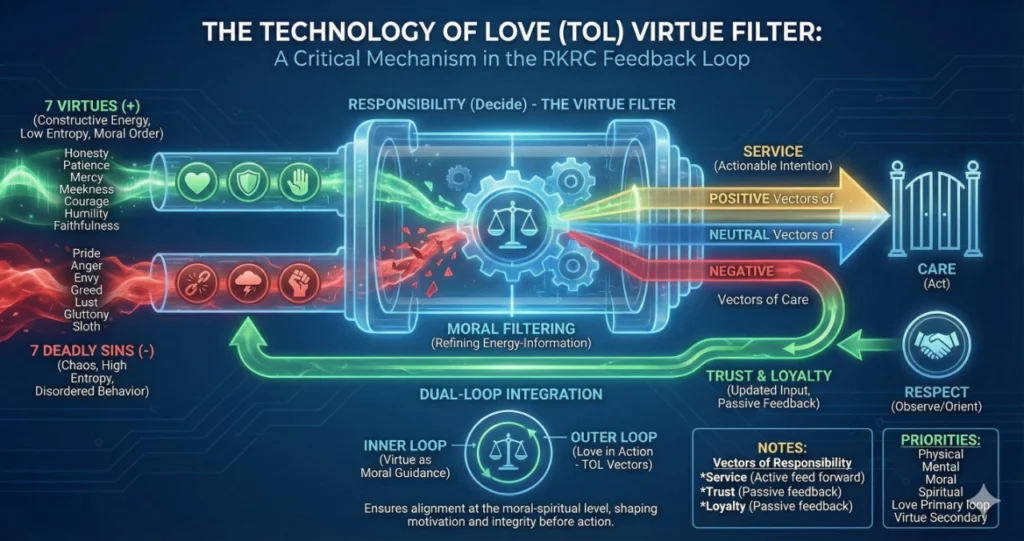
The dynamics between the Seven Virtues and the Seven Deadly Sins play a key role within Hansen’s theory of love (TOL). These moral forces act as a filter within the “Responsibility” phase of the RKRC decision-making loop, shaping how love is perceived and conveyed. Virtues serve as weighting factors—guiding our discernment of whether or not love is present in human interactions. Let’s explore the new science in more detail.
Figure 1: CSiPub 25112 – TOL’s Virtue Filter
Historical Context: “One Science”
Early Greek thought, philosophy and physics were unified as one science. Religion was another matter. Over time, our understanding of ourself and of the world has evolved dramatically. Love, once simply explained with four Greek expressions—Agape, Phileo, Storge, and Eros—has remained a central theme in both scripture and human experience.
Religion and Morality
Virtue emerged as an empirical moral framework—a counterbalance to sin. This dynamic between good and evil has endured across cultures. With TOL, we now have the tools to integrate virtue and love into a unified scientific model through systems theory.
Reuniting the Sciences through the Technology of Love
Advances in knowledge have begun to bridge the divide between philosophy, physics, and religion with the understanding love as a science. No sources are over looked from Jesus to Einstein. As Hansen observes, “Jesus has taken the back pew,” overlooked as a source of important insight into love, the very foundation of Christianity. Einstein suggests we study love as we actually perceive it, as an “everyday sensual experiences”.
Hansen’s breakthrough was to define love scientifically in four dimensions—Spiritual, Moral, Mental, and Physical—using systems theory. His work, published in 2005 after 30 years of research, offers a structured lens through which we can examine the role of virtues in love.
Virtues Found Within the RKRC Loop
Referencing Figure 1 (above), we see how virtues function within the “Responsibility” phase of the RKRC loop (Respect, Knowledge, Responsibility, Care):
- Virtues reside in Responsibility, shaping decisions through moral filtering. Reference the book Technology of Love Vol 1, Chapter Love’s Spontaneous Order (Part 1), and Index entries: “Virtues” pp. 6, 219–220, 222, 226, 246, 256, 261–262, 303–304, 350, 391; “Virtuous” pp. 22, 25.
- Virtue-Responsibility acts as a secondary feedback loop, refining the energy-information that flows into Care. This alignment with virtue or sin influences our perception of love.
- Responsibility breaks into three vectors:
- Service → feeds forward into Care for action
- Trust and Loyalty → feedback to Respect as an updated input.
- Virtues (left side of Fig 1): Enable constructive energy-information, moral order, and low-entropy outcomes.
- Sins (right side): Initiate chaos, distort energy flow, and lead to high-entropy, disordered social behavior.
Decision-Making Evolution
- Moses’ Ten Commandments: A fixed moral code—no feedback loop. “Thou shalt not” rules remain influential but inflexible.
- Jesus “Love Thys” tells us what, but not how?
- Einstein suggests a scientific approach. Refining everyday thinking and perceiving general principles from empirical facts.
- Virtues: Evolved empirically through lived experience. Often taught through moral storytelling—e.g., “Knock-knock, who’s there? It’s the devil.” These serve as rule-of-thumb filters but lack scientific grounding.
- Example: Honesty and Patience (Virtues) counteract Pride and Anger (Sins). Useful for judgment calls, but not yet a scientific model of love.
The RKRC Loop: A Systems Theory Based Model of Love
Hansen’s RKRC Loop—Respect, Knowledge, Responsibility, Care—uses systems theory to define how love operates in real-world interactions. It integrates the virtue-sin dynamic as a secondary loop within love, forming a hybrid of Col. Boyd’s OODA loop (Observe, Orient, Decide, Act). Care is the equivalent to Boyd’s Act[ion].
Unlike traditional decision models, when it’s comes time to act, TOL has a defined set of Action Elements of Care (AEC)—thermodynamic ordered behaviors, that either convey love (positive) or its absence (negative). This enables scalable AI mapping of relational dynamics to define human interaction for mutual benefit (HIMB) and social order.
The 10 Positive AECs of Care (aka “10 vectors of love”) are Attentiveness, Listening, Thanking, Praising, Encouraging, Comforting, Assisting, Sharing, Contributing, Protecting.
Negative AECs are defined in thermodynamic descending disorder as: Threatening, Demeaning, Deceiving, Subjugating, Rejection, Violating, Extracting, Constraining, Injuring, Destruction.
TOL Action-Reaction for example: Again, “Knock knock, who’s there? TOL response to a Threatening vector (negative) by taking action with love applying vectors such as Attentiveness, listening vectors (positive)., or by applying other counter measures using Virtues as empirical experience would suggest.
Summarizing-Love and Virtue: Two Interlocking Decision-making Loops
- Outer Loop – Love in Action (TOL’s 10 Vectors)
These are the actions of Care we take—practical, relational, and thermodynamic. They influence order-disorder, chaos, complexity, and how relationships hold together. - Inner Loop – Virtue as Moral Guidance
These are inner qualities like patience, courage, and humility. They shape the motivation, integrity, and sustainability of our actions. ensures intention, alignment, and depth at the moral-spiritual level - Together, decision loops form a nested feedback system amplifying or dampening effect on the Action Elements of Care (Love):
The Power of Virtues-Why This Matters in a dual-loop scientific model:
- Prevents virtue signaling without care
- Avoids care actions that lack moral integrity
- Enables adaptive, ethical, and thermodynamic, rational, decision-making
- Creates self-correcting systems of love and virtue
Concluding Thoughts
TOL is a living process—where Love acts, and Virtue reflects, creating a rhythm of healing, order, transformation, and illumination.
- Love, the new science, making sense of chaos (entropy)
- Virtues make Love understandable, manageable, and productive
- Holistic Healing Hippocratic oath- body, mind, spirit
- AI assisted Game Theory modeling and problem solving
- Enhance critical thinking evolved in decision-making and conflict resolution
- Illuminate Care-Love in four dimensions- Spiritual, Moral, Mental, and Physical
- “One Science” unifying the sciences of philosophy, physics, and religion
- “Love thy enemy” a grand strategy for not “what to do” but “how” to achieve a win-win
- Love empowered by virtues is action, more than just an emotion or feeling
