
Colonel John Boyd was a maverick fighter pilot in the U.S. Air Force during the Vietnam war era that went on to work at the Pentagon and have a large influence on US military strategy in the 1970s, 1980s and 1990s. His ideas and theories had a strong influence on the Pentagon and even on educational institutions and businesses today.
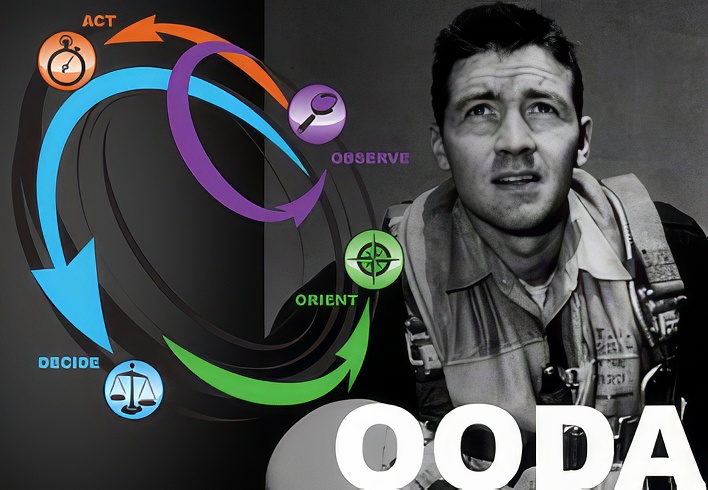
In the 1970s, Boyd revolutionized military strategy with his OODA loop theory, a framework for understanding decision-making in conflict. Boyd conceptualized combat as a dynamic duel in which each participant continuously cycles through four stages: Observe (O) the opponent’s actions, Orient (O) oneself to the evolving situation, Decide (D) on the best response, and Act (A) accordingly. The competitor who moves through this loop faster gains a decisive advantage, disrupting the enemy’s ability to react effectively.
Boyd demonstrated that these cycles generate continuous, unpredictable change, arguing that effective tactics, strategies, and technologies must be designed to shape and adapt to this fluid environment—preferably at a pace that outstrips the adversary’s ability to adjust.
While the idea of disrupting an opponent’s decision-making process has long been a feature of military theory, Boyd’s insight into operating within an adversary’s decision cycle—rather than merely disrupting it—was a groundbreaking innovation. His goal was to sever the enemy’s connection to reality by undermining their ability to accurately perceive and adapt to their environment. Central to this theory is the concept of orientation: the framework through which individuals interpret and respond to their observations.
A person’s decisions are shaped by mental models that help us interpret the world. These models, or paradigms—concepts explored by thinkers like Konrad Lorenz and Thomas Kuhn—are constantly evolving as they interact with external realities. In conflict, each participant, from foot soldier to strategist, must make decisions based on their understanding of unfolding events. Boyd argued that orientation is an ongoing process of analysis (applying existing knowledge to new observations) and synthesis (developing new knowledge when old paradigms fail to provide clarity).
The synthesis process is crucial because it allows individuals or groups to develop new worldviews when faced with novel challenges. However, as Kuhn noted, paradigm shifts are often painful, requiring the destruction of existing frameworks. Boyd sought to exploit this vulnerability by delivering rapid, unpredictable actions that shattered an adversary’s ability to maintain a coherent worldview, or orientation. By keeping opponents in a perpetual state of confusion, doubt, and psychological distress, he aimed to overload their capacity to adapt—leading to paralysis, fear, and ultimately, defeat.
Changing The Paradigm
Boyd’s OODA loop is not just a theory of warfare; it has influenced fields as diverse as business, sports, and cybersecurity, proving its relevance in any competitive environment where rapid decision-making is key to winning. While the paradigm of competition, with it’s emphasis on survival of the fittest, has it’s roots in observable nature, might it be time to rethink this mindset as innovators create super intelligent agents and begin putting them into machine bodies? Many scientists and technologists have issued dire warnings to governments and society about the risks to humanity. It is clearly obvious and evident that if machine intelligence exploits the vulnerability in our existing winner-takes-all paradigm, a strategy that Boyd used to win wars, then it’s humanity that will eventually be defeated by its own creations.
Franklin C. Spinney, a former Air Force officer and engineer at Wright-Patterson Air Force Base in Ohio, worked with Boyd directly as a civilian systems analyst at the Pentagon to build evidence-based support for his leaner, faster military. Charles Hansen, also a former officer at Wright-Patterson, researcher, and economist in Washington DC, was close to Spinney from their Air Force days and provided research and support outside the Pentagon for Spinney’s work. Hansen’s research into competition in global economics and his many philosophical conversations with Spinney “while sailing the beautiful Chesapeake Bay” (Technology of Love, Preface v) led him to wonder what a different paradigm might look like.
Leading researchers and academics of the 20th Century such as Sigmund Freud, Carl Rogers, Pitirim Sorokin, Talcott Parsons, Abraham Maslow and Eric Fromm had all contributed to the theory that “human nature was fundamentally motivated by, naturally attuned to, and innately predisposed toward the attributes of Love as our highest ‘operational’ priority” (Technology of Love, Preface iii). Building on this framework and the pragmatic focus of Boyd and Spinney, Hansen began to realize that Love might actually be “limited by what an individual human could actually do— deliberately, in the mind or in action; and that it might be closely related to conditions of order and disorder within the individual human system and its immediate environment.” (Technology of Love, Preface v).
Hansen thus founded the Corsense Institute on the premise of a new paradigm, namely one of Mutually Beneficial Human Interaction (MBHI©), a pragmatic approach for a future that makes life more rewarding for everyone and may preserve humanity from eventual destruction. The model for this new paradigm is a derivative of Boyd’s OODA Loop that consists of the primary practical components of love: Respect, Knowledge, Responsibility and Care, referenced as the RKRC-Loop©.
The model operates by encouraging individuals to internalize and apply the RKRC attributes in their daily lives. Here’s a breakdown of the process:
- Respect: Recognize the inherent worth of oneself and others, fostering a foundation of mutual appreciation.
- Knowledge: Seek understanding and awareness, enabling informed decisions and empathetic interactions.
- Responsibility: Acknowledge and accept the consequences of one’s actions, promoting accountability.
- Care: Act with genuine concern for the well-being of others, which is operationalized through the Perfect 10 actions.
By consistently applying these attributes and actions, individuals can enhance their decision-making processes, leading to more compassionate and effective outcomes.
So the RKRC Loop is correlated to the OODA Loop in the following way:
- Respect through it’s causal elements of Awareness, Acceptance and Admiration (Observe).
- Knowledge through it’s processes of Objectiveness, Positiveness, Conscientiousness, Humility, Patience, Transposition, Forgiveness and Transcendence (Orient) leading to better Understanding and more Awareness (Observe).
- Responsibility through its causal elements of Trust, Loyalty and Service (Decide).
- Care via Love’s ten action elements (Action).
This new model for decision-making can be implemented by a single individual willing to change their personal paradigm to achieve mutually beneficial human interactions, commonly referred to as win-win interactions. It becomes more powerful when implemented in groups, and even more powerful and rewarding for everyone when implemented in societies.

Boyd’s “A” calls for action in general, as Hansen’s “C”, Care signifies specific actions required to convey Love. Hansen goes into scientific detail as to what these actions must be to prevail for love to be conveyed between individuals. They have become known as the 10 Action Vectors of love and can be beneficially applied in some optimal combination with the “intent to please”. Since there is a mathematic concept here, vectors carry with it properties of direction and intensity associated with every action.
TOL’s rule of thumb to stay in positive systems territory act accordingly: Attentiveness, Listening, Thanking, Praising, Encouraging, Comforting, Assisting, Sharing, Contributing, Assisting, and finely Protecting.